

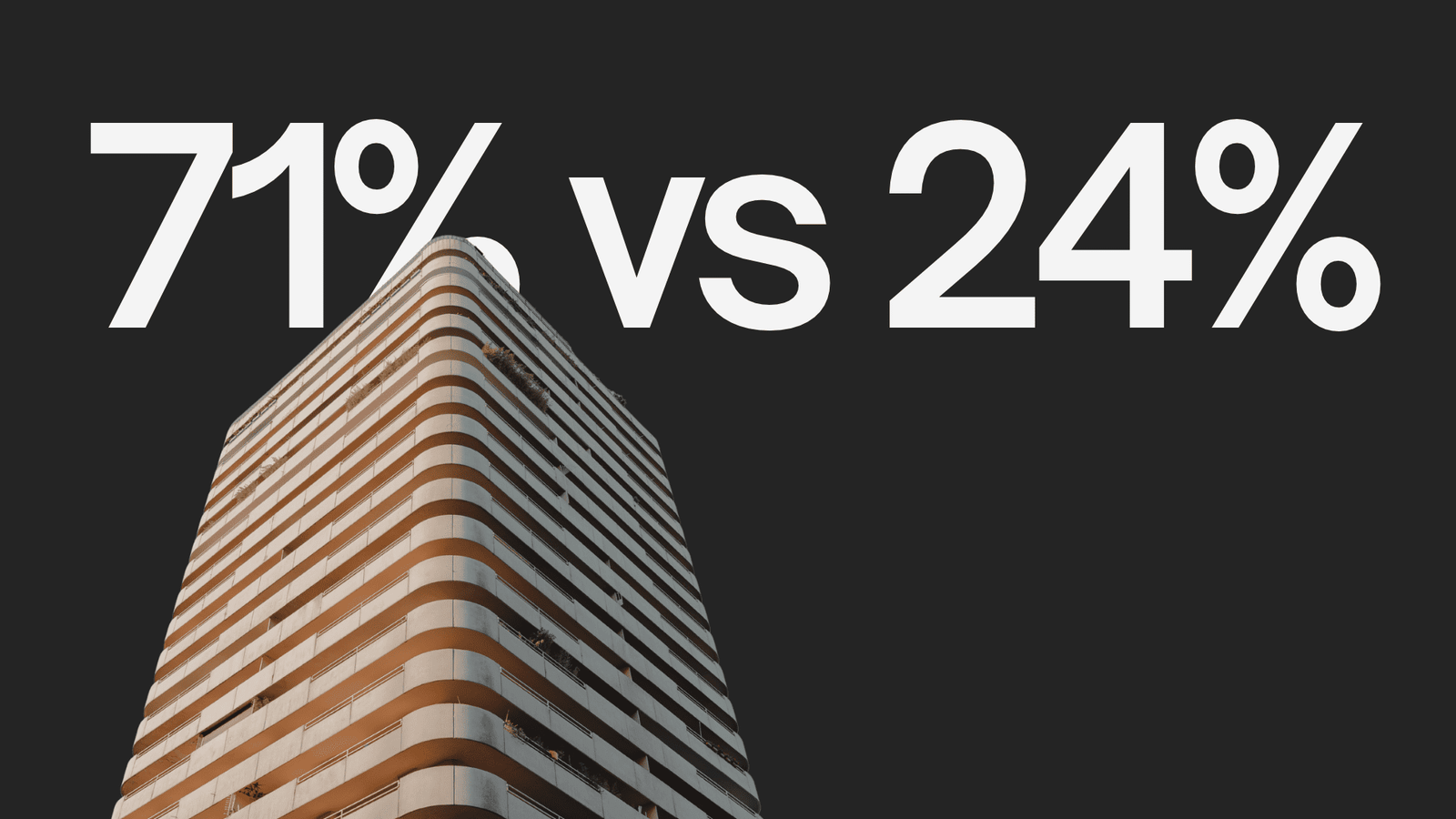
Ask three research teams how many large companies run AI agents and you get three answers. Zapier found 71% of enterprise leaders have agents in production. Sinequa found 51% say the same, then cut the number to 24% once it asked whether the thing is a real agent. CrewAI found 65% already using agents. Nobody is lying. They are answering different questions, on different people.
Three surveys, three definitions
- Zapier (513 US managers and executives at companies with 1,000+ employees, fielded 16 to 21 September 2026): 88% use or test agents, and 71% have them in production, up from 40% a year earlier.
- CrewAI (500 senior leaders at companies with $100M+ in revenue and 5,000+ employees, published 11 February 2026): 65% already use agents, and 81% say adoption is fully scaled or scaling.
- Sinequa, part of ChapsVision (740 senior leaders at $1B+ enterprises): 51% report agents in live production, but only 24% have deployed something that qualifies as a true agent, and only 10% have real agentic capabilities.
The gap is a definition problem
Sinequa says most of those production deployments are assistants and workflow-guided AI, not autonomous agents. Its report also found 84% of leaders have come across products marketed as agents that are really sophisticated chatbots. That is the polite name for the problem: agent-washing. It would explain how “agents in production” can read 71% in one survey and 24% in another.
Autonomy is the number to watch
Adoption tells you a tool exists. Autonomy tells you whether it does the work. In Zapier’s data, only 30% of leaders say their agents complete more than 60% of assigned tasks without human help. When more than half of a company’s agents sit inside broader automated workflows, that share jumps to 77%. When half or fewer do, it drops to 8%.
CrewAI’s respondents say the average company has automated 31% of its workflows with agentic AI. Different question, so don’t merge the two figures. But neither one describes a world where agents have taken over.
Who paid for the data
Each publisher sells software in this space: Zapier sells workflow automation, CrewAI an agent platform, and Sinequa enterprise AI search and agent tooling.
That doesn’t make the numbers wrong. Zapier publishes its method, including unweighted data and a margin of error of about 4%. But a headline built for a sales pitch deserves a second look, and the 77% versus 8% gap is best read as a hypothesis from a workflow vendor, not a verdict.
CrewAI’s finding that 100% of respondents plan to expand agent use is a cue to ask who was asked.
Four questions to ask before you repeat an agent statistic
- What counts as an agent? A chatbot with one tool and a system that plans and acts across steps are different products.
- Production for whom? One team’s pilot and a company-wide rollout can both tick the same box.
- How much human help? Look for a share of tasks finished without intervention, not a yes or no.
- Who sells what? Check the publisher’s product, the sample and the date before you quote the number.
What it means if you buy or build agents
So track two numbers of your own: the share of tasks an agent finishes without a human, and what each finished task costs. Adoption percentages make good slides. Those two make good decisions.
One hedge on reliability is to have a different model check an agent’s work, which is the lesson of Modelodge’s look at open-weight code reviewers.
Frequently asked questions
How many companies use AI agents in production?
It depends on who is asked and how agents are defined. Zapier’s 2026 survey found 71% of enterprise leaders have agents in production, Sinequa’s found 51%, and CrewAI found 65% already using them. Sinequa says only 24% have deployed a true agent, so treat headline adoption figures with caution.
What is agent-washing?
Agent-washing is selling a chatbot or scripted assistant as an AI agent. Sinequa’s 2026 survey found 84% of enterprise leaders had met products marketed as agents that were really sophisticated chatbots. A true agent plans steps, uses tools and works toward a goal with some autonomy, rather than only answering questions.
Do AI agents work without human oversight?
Mostly not yet. In Zapier’s 2026 survey, only 30% of leaders said their agents complete more than 60% of assigned tasks without human intervention. Agents connected to wider automated workflows did far better: 77% of those leaders reported that level, against 8% for everyone else.
What stops companies from scaling AI agents?
Trust, security and data. Sinequa’s report lists reliability and hallucinations (43%), security and privacy (42%) and accuracy (40%) as top barriers. Zapier’s respondents most often cited privacy, security and compliance risk (27%), then accuracy and errors (24%). CrewAI’s leaders pointed to data readiness (35%) and talent (33%).




Leave a Reply